Header

Facebook Pinterest Blog Home
Showing posts with label Nutrition. Show all posts

Thursday, April 18, 2013

Coconut Oil for you Health


You have probably seen on Pinterest, many ways to use Coconut Oil not only for cooking and baking but also for your body and ailments.
At THIS site they have comprised many health facts using various sources over the internet.
Here is one of the reported cures from research they mention:

  • VIRUSES/BACTERIAL INFECTIONS/FUNGUS/PARASITESStudies have found that coconut oil can kill viruses that cause influenza, herpes, measles, hepatitis C, SARS, AIDS, and other illnesses. It also kills bacteria that cause ulcers, throat infections, urinary tract infections, gum disease and cavities, pneumonia, and gonorrhea, and other diseases; Kills fungi and yeasts that cause candidiasis, ringworm, athlete's foot, thrush, diaper rash, and other infections; Expels or kills tapeworms, lice, giardia, and other parasites; Coconut oil may provide an effective defense against many parasites including giardia. Like bacteria and fungi, giardia can't stand up against MCFA found in coconut oil. Research has confirmed the effectiveness of MCFA in destroying giardia and possibly other protozoa. By using coconut oil every day, you may be able to destroy giardia. Another possible use for coconut is for the removal of intestinal worms. In India it has traditionally been used to get rid of tapeworms. In one study it was reported that treatment with dried coconut, followed by magnesium sulfate (a laxative), caused ninety percent parasite expulsion after twelve hours. In India coconut oil is also rubbed into the scalp as a treatment to remove head lice. 
Crazy stuff! Please visit the link for the site I mentioned above for a lot more interesting research they have found of Coconut Oil helping/curing various ailments.

Coconut Oil should not only be something that you keep in your everyday kitchen pantry, but is something that you should have in your "Prepper Pantry". It would be good to have Coconut Oil on hand for health benefits if something were to happen that made it difficult to get medication.

Disclaimer: We are not medical professionals. This information is based off of research from various sites on the internet.Only your health care provider, personal physician, or pharmacist can provide you with advice on what is safe and effective for your unique needs or diagnose your particular medical history. 

Wednesday, April 17, 2013

Will cooking with Coconut Oil cause it to become hydrogenated and toxic like hydrogenated oils? (Recipe Included)


No. Hydrogenation is an industrial process where hydrogen molecules are introduced to the oil to make it solid at room temperatures. It chemically alters the oil and creates harmful trans fatty acids. 
Cooking with coconut oil does NOT introduce hydrogen into the oil or hydrogenate it. 
Coconut oil is a very stable oil even at higher temperatures.  However, it is best not to cook beyond the smoke point of coconut oil, as this will begin to deteriorate the oil and turn it yellow. Unrefined coconut oil smokes in the range of 350° F. That's about the same as butter or lard. A more refined coconut oil would have a higher smoke point (just above 400° F). Once it has turned dark yellow, the oil should be discarded and no longer used.


Here is a great recipe that uses cooking with Coconut Oil 
(The kids will LOVE these)

Chicken Nuggets Fried in Coconut Oil
Servings: 8
Preparation Time: 10 minutes
Mix all ingredients except coconut oil together until well blended. Add more breadcrumbs if mixture looks too sticky.
Heat coconut oil in a pan over medium heat and drop chicken mixture into pan, shaping into nuggets. Cook until golden brown on both sides and serve.

You can find this recipe HERE

To find more information on Coconut Oil and answers to most frequently asked questions about Coconut Oil, go to THIS fantastic site.

If you live in the Southern Utah area and would like to purchase some Coconut Oil through a group order. Please contact us at chillylizard@gmail.com

Wednesday, April 10, 2013

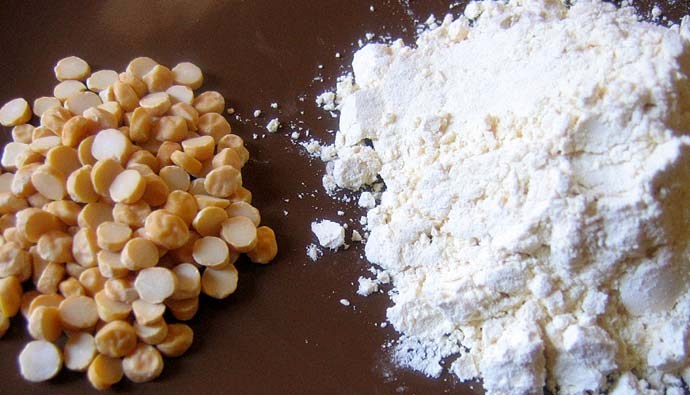
Make Your Own Chickpea Flour


You will find in some Indian, Turkish, Italian, Spanish and French recipes that it will ask for chickpea flour. But finding a store that stocks chickpea flour can be difficult. Here is how you can make your own in little to no time at all.
Chickpea flour — also known as besan, gram flour, channa flour, harina de garbanzo — is a popular ingredient in many Old World cuisines. It is the used in the batter for Indian pakoras. The French of Provence make a popular bread called soccawith it that they bake in wood-fired ovens. Persian Jews mix it with ground chicken to form gundi dumplings. Chickpea flour can also be a great substitute for wheat flour in many recipes and for thickening sauces. Good news for those who want to go gluten-free!
Here's how to make your own. It should yield around 1 1/2 cups.

Chickpea Flour Recipe

  • 2 cups of dried chickpeas
  1. Add the chickpeas in small batches to a food processor, coffee grinder or blender and process until pulverized and smooth.
  2. Run through a sieve to remove any large particles. Use as directed in recipes.
  • Toasted Chickpea Flour: toast the chickpeas in a 400°F oven for 15-20 minutes, or until the chickpeas start to give off a toasted aroma and are lightly browned. Cool and proceed with the recipe above.

Friday, April 5, 2013

Crispy Roasted Chickpeas (Garbanzo Beans) - Recipe

Don't these look so yummy. These are Crispy Roasted Chickpeas and they are super easy to make. You only need 4 ingredients. Please go HERE to get the recipe and step-by-step instructions (with pictures).
You won't be sorry!

Thursday, April 4, 2013

Garbanzo Beans (Chickpeas)


Garbanzo beans are a versatile and tasty legume. They can be tossed into salads, roasted, stirred into stews and mashed into a tasty, Mediterranean dip. But these tiny legumes are not only delicious, they also offer a lot of nutritional value. If you don’t already have garbanzo beans as a staple in your pantry, after reading the following nutritional information, you will most likely want to.

Protein

Garbanzo beans are a great source of dietary protein. Vegetarians would do well to add garbanzo beans to their diets. When paired with whole grains, garbanzo beans provide a source of protein comparable to that of meat or dairy products, without the worry of saturated fat or cholesterol. One cup of garbanzo beans supplies roughly 27 percent of daily protein requirements.

Fiber

Garbanzo beans, like other legumes, are rich in dietary fiber. Garbanzos contain both soluble and insoluble fiber. Each type of fiber works in different ways to keep the body in healthy, working order. Soluble fiber works in the digestive tract to move excess cholesterol out of the body. Insoluble fiber helps to prevent constipation and other digestive disorders. One cup of garbanzo beans supplies almost half of the recommended daily allowance of dietary fiber.

Manganese

Garbanzo beans contain significant amounts of the trace mineral manganese. Manganese plays an important role in energy production. It’s also an important component in the body’s antioxidant activity.

Folate

Garbanzo beans are also a good source of folate. This nutrient is vital for women of childbearing years. Consuming adequate levels of folate prior to pregnancy can prevent certain birth defects, such as spina bifida. One cup of garbanzo beans contains 70 percent of the RDA for non-pregnant adults.

Iron

Garbanzos beans are a good source of iron. Iron is important for energy production. Deficiencies often result in fatigue. Iron is especially important to menstruating women, as significant amounts of the mineral can be lost due to heavy periods.

Selection

Garbanzo beans can be purchased dried or canned. Look for whole, uncracked beans that are free from moisture, when purchasing dried garbanzos. Canned beans are a convenient way to purchase garbanzos. Unlike vegetables, garbanzo bean’s nutritional components hold up well to the canning process. Their protein and fiber content are only lowered slightly when canned. However, canned garbanzos do have significantly lower levels of folate than the dried beans. The canning process can deplete folate levels as much as 45 percent.

Storage

Dried garbanzo beans are best stored in an airtight container. Place the container in a cool, dry place, away from sunlight, and they will keep for well up to a year. Once cooked, garbanzo beans may be placed in a container and stored in the refrigerator for 3 or 4 days.

Preparation

To lower their sodium content, drain and rinse canned garbanzos before use. Dried beans should be soaked prior to use. This is simple to do. Just place the garbanzo beans in a container of water and soak overnight.

Wednesday, April 3, 2013

Whole Wheat Bread Recipe WITH Coconut Oil!?


WHOLE WHEAT BREAD

Put all of these ingredients in Bosch and mix well:

9 Rounded Cups fresh ground hard wheat
2 T Salt
½ C Powdered milk

Add:
½ C Expeller Pressed Coconut Oil (or oil of your choice)
½ C honey (or sugar of your choice)
2 T Lecithin (supplement)
3 Eggs
5 C of very hot water

Turn mixer on an d as soon as dry ingredients are moistened add 2 ½ rounded T of
LeSaffe dry yeast while mixer is running. You may need to add up to 3 C of WHITE
flour while it is mixing if the dough doesn’t begin to clean the sides of the bowl. Keep it
“sticky” – makes a better loaf.. Mix for 10 minutes on 3 speed.

Take the dough hook out and cover the dough in the bowl; let set until dough rises to the
top of the lid.

Put out on floured surface and divide into 6 loaves. Form into loaves and put into large
non stick pans. Cover and let rise in warm place. (If not using non stick pans it works
best if you put some type of oil or shortening in the pans).

Let raise until double (or light). Bake at 350 degrees for 35 minutes (ovens vary).

Monique Jackson's Wheat Bread Recipe


Monique Jackson’s Wheat Bread – September 2009


6 C warm water
2 T Vital Wheat Gluten
3/4 C oil
2 T Powdered Milk or Instant Milk
3/4 C honey
2 T Dough Enhancer
2 T yeast
2 T Salt
15 C wheat flour

Put all 8 ingredients in Bosch with 6 ups of ground wheat flour and mix on speed 1 for 1
minute. Watch to see that the yeast is active and forming bubbles. Add 9 C of remaining
wheat flour. Mix for 10 minutes. Butter counter, put dough on counter with butter side
up and let rest 10 minutes. Cut into 4 equal sections and mold into 4 buttered 2 pound
loaf pans. Turn oven on to 170 degrees for one minute and then turn oven off. Place
pans in oven and set timer for 30 minute. After 30 minutes turn oven to 350 degrees
leaving pans in oven while it warms to 350 degrees. Bake for 34 minute.

•    I’ve even baked this in a Solar Oven & it turns out fabulous!

How To Take The Gas Out Of Lentils


Lentils are inexpensive legumes that are full of high-quality protein, fiber, iron, phosphorous, manganese and vitamin B1. These versatile vegetables also are free of cholesterol and slim on fat content. The outer coatings of lentils contain a substance called oligosaccharides, which is a complex sugar that can cause flatulence. Certain steps can help take the gas out of lentils, however.

To find out the steps go HERE to the original article. 

Tuesday, April 2, 2013

Ten Things You Probably Didn't Know About Lentils


Lentils have been a part of the human diet since the Neolithic times. These protein packed members of the legume family are just as easily served in a side dish as they are as a main course. Here's a list of ten things you didn't know about lentils.

1. Lentils are the only beans that don't need to be presoaked. Most types of beans in the legume family need to be soaked for hours prior to cooking to soften their tough outer shell. Lentils need only be pre-rinsed briefly before cooking.
2. There are ten different types of lentil beans. Brown lentils are by far the most common type of lentils beans, finding their way into lentil soups and casseroles most frequently. There are ten different types of lentils however, ranging in color from red to pink to yellow. Lentils also come in different sizes.
3. Lentils originated in central Asia. Lentils were one of the first crops to be cultivated by humans and date back to Neolithic times. Lentil seeds were recently discovered in Asia that date back more than 8,000 years. Lentils were later introduced to Egypt and Greece pre Biblical times. In the United States, lentils didn't make an appearance until the early 1900s.
4. Canned lentils do not lose nutritional value. Most vegetables and beans which are processed and then canned lose much of their nutritional value. Lentils retain their nutrition whether dry packed or canned.
5. Lentils provide more folic acid than any other unfortified food. One cup of lentils provides 90% of the recommended daily intake of folic acid, a crucial nutrient. Lentils are also an excellent source of protein, molybdenum, manganese, iron and fiber.
6. Lentils are considered the food for mourners. In Judaism, the round shape of the lentil bean is said to signify the circle of life.
7. There's a National Lentil Festival in the United States. Since 1989, the National Lentil Festival has been held in Pullman, Washington, where over one-third of the US lentil crop is grown. Festival goers enjoy an annual parade, lentil cook off, beauty pageant and golf tournament.
8. Lentils are a good legume for diabetics. Most legumes in the bean family are high in carbohydrates and must be eaten sparingly by those with diabetes. Unlike their cousins, lentils are high in soluble fiber and low in carbohydrates, and have been proven to decrease serum glucose levels and cholesterol.
9. Small lentils are more flavorful. The smaller lentils, mostly grown in the Middle East, are packed with flavor and considered to be the more favorable lentil for cooking. Larger lentils, more common in North America, lack the intensity of their smaller cousins.
10. Lentils were once used as packing material. The packing peanut industry grew out of lentils, which were used in earlier times in the middle to secure packages for safekeeping during shipping.

Monday, April 1, 2013

Brown, Green, and Red. Is there a difference?


There is a broad variety of lentils, but here are the most common kinds of lentils we see in stores:
Brown Lentils - This is by far the most common variety of lentil, and probably the one that you see at your local grocery store. They can range in color from khaki-brown to dark black, and generally have a mild earthy flavor. They cook in about 20-30 minutes and hold their shape very well. Common varieties are Spanish Brown, German Brown, or Indian Brown. The blackest and tiniest lentils you find are usually Beluga lentils, which have a rich and deeply earthy flavor.
Green Lentils - These can be pale or mottled green-brown in color with a glossy exterior. They have a strong, somewhat peppery flavor. Green lentils generally take the longest to cook, upwards of 45 minutes, but they keep a firm texture even after cooking. This makes them ideal for salads and other side dishes.
Red Lentils - With colors ranging from gold to orange to actual red, these are the sweetest and nuttiest of the lentils - to our mind, at least! They're somewhere in the middle in terms of cooking time and are usually done in about 30 minutes. They tend to get mushy when cooked through, so they're perfect for curries, or for thickening soups. A few varieties are Red Chief and Crimson, and you'll often find them in Indian or Middle Eastern markets labeled as masoor (red lentils) or channa (yellow lentils).
Do you have a favorite kind of lentil? What do you like to make with them?

Friday, March 29, 2013

Facts on Lentils


Lentils are the world’s oldest cultivated legume, appearing on the scene somewhere in the neighborhood of 7000 BCE! The name comes from the fact that the shape of a “len”til looks like the “len”s of an eye. And, like eyes, lentils vary in color ranging from black to brown to reddish orange, coral, gold and slate green. They’re easy to prepare and cook more quickly than many other legumes. Different varieties have different textures and are generally used in different types of recipes. For example, brown and green lentils hold their shape well and are great for casseroles, salad, or to ladle over grains or potatoes, whereas split red or yellow lentils disintegrate easily when cooking and are perfect for soups and stews. Adding lentils to your diet is a tasty way to improve your health. Consider that they are high in fiber, packed with plant protein, low in fat and low on the glycemic index, which means they don’t cause a spike in blood sugar after eating. The USDA Nutritional database shows that one cup of cooked lentils contains:
  • 220 calories
  • 17 grams of protein
  • Less than 1 gram of fat
  • 15 grams of fiber
  • 0 cholesterol
  • Iron, phosphorus, folate and plenty of other good stuff

Tuesday, February 12, 2013

Grandma's Country Cream 100% Real Powdered Milk


My family has recently acquired a 25 lb bucket of Grandma's Country Foods Country Cream 100% Real Milk Powder. I had heard that it is much better than most powdered milks in the fact that it tastes creamy and completely dissolves in the water as to not leave a grainy taste. 
My family drinks a lot of milk, especially my 2 year old, he goes through a gallon in about 3 days. A few days ago we had finished all of our store bought milk, which meant it was a perfect time to try out our new powdered milk. I mixed 2 2/3 cups of powder with 1 Gallon of Water as it directs on the bucket. I put it into the fridge to get cold and then I gave some to my 2 year old to try it out. He guzzled it down and couldn't tell the difference. My husband tried it out and he liked it but said it tasted a lot like skim milk, so I added a bit more powder to the mixture and it gave it a richer flavor. I tried it after everyone else tried it out ( I love milk and I'm very picky at where we purchase milk. I would drink Raw milk all day if I had access to a cow.) and I found it didn't taste like store bought milk, but it wasn't bad. It was quite good and tasted pretty close to 2% milk. AND it completely dissolved with the water, there was no grainy taste! I am totally SOLD on this product!

You can bet that my family will be using this whole bucket up to save us on a lot of money especially with milk prices going up.A bucket of powder allows you to make up this milk at about $1.62/gallon. If you would like more information on Grandma's Country Cream Powdered milk please email us at: chillylizard@gmail.com. If you live in Southern Utah and would like to know prices for ordering some Grandma's Country Cream Powdered Milk, please email us at chillylizard@gmail.com too.

This guy sure approves!


Sunday, February 10, 2013

Spelt - 3 Tips to Higher Loaf Volume


Three tips to achieve higher loaf volume while using Spelt:

TIP #1
*  Take 1/2 of all ingredients (including the yeast), place in bowl and mix until you produce dough.
*  Cover and place in accessible spot for later use.
*  Within 5 to 12 hours add the remainder of all ingredients to the bowl (sponge dough), mix to produce the dough and proceed as you would normally.

Spelt flour is high in complex carbohydrates and, thus, needs to have some of the complex carbohydrates reduced to simple sugars so that the yeast will have a strong food source. By setting a sponge, you are releasing the enzymes in the flour that are activated when wet, to begin the conversion process. The resulting bread will have better cell structure, greater loaf volume and a lighter crust.

TIP #2

*  Replace some whole grain spelt flour with white flour - you will get more volume and a lighter loaf while still keeping many of the good characteristics of whole spelt.

TIP #3

* Add dough enhancer or an egg to your bread


Check out:  http://www.histakes-spelt.com  for more info on Spelt.  Excellent site.

Saturday, February 9, 2013

You can BAKE with Spelt


Question: What changes should you make when you add spelt to your dough mixtures for any baked good?

Baking with spelt is similar to baking with other flours, however, due to spelt's solubility, bakers often notice that a little less water is required. When using your favorite recipes, it is suggested that you use 3/4 of the liquid that you normally would use. More liquid can then be added until the look and feel of the batter is satisfactory.

**Be sure you make note of what you do so you can repeat your successes**

Spelt has fragile gluten meaning that the initial mix time (when water is first added to the flour) should be no more than 4 minutes - although 3 1/2 minutes is ideal.

Mix the flour/liquid enough to get the dough to become homogenous.
Once mixed, you can treat the dough as though it were made with regular wheat.


Check out www.histakes-spelt.com for more information & recipes

Sunday, January 27, 2013

Save $ on your Food Bill

Fruit Basket is 1/2 of your distribution


Veggie side of the basket is the other half

Baskets ready for pick up
Bountiful Baskets.org is an excellent resource for FRESH, top of the line produce in several states.  Check it out and see if it's in an area near you!  I've been involved as a volunteer site coordinator for several years here in Utah and it's always surprising to me how many people do NOT take advantage of this resource.  Food prices have gone up A LOT in the last 2 years and the price for Bountiful Baskets has stayed the same - only $15 for a distribution of Fruit AND a distribution of Vegetables (check out the pictures).  Bountiful Baskets is coordinated by Kodiak Produce out of Arizona.  

Here's how it works:

1.  Go to www.bountifulbaskets.org

2.  Sign up for a new account (this will cost you $3 to join the food co-op)
3.  If you live in Utah - Monday & Tuesday are the days that you can log in and ORDER.
4.  Make sure you pick the State - County - City and proper SITE where you will be picking up the food.  (It's a drag if you order at a site and can't get there).
5.  Ordering closes on Tuesday - so if you miss it; you're not going to be able to get anything on Saturday.
6.  Everything you ordered on either Monday or Tuesday gets delivered on Saturday.
7.  The general basket is $15; they do not publish what will arrive in the baskets. 
8.  They usually have EXTRA items (for an extra charge) that you can choose from which mean they have access to some other supplies that you can have shipped in with your basket; like breads; juice packs (these are a crazy good deal, large bag); sometimes cookies - lots of stuff.
9.  NOTE:  Be on time.  If you aren't there to pick up your things; your items are donated to a local Fire Department with no - refunds.
10.  You can't choose what is in the fruit & vegetable basket so if you're worried about what to do with it all ... be creative; look up recipes and use the internet resources to help you.  One mystery meal a week is good for the soul.

Another Great resource (IN UTAH) is JumboJoes.com
.  They are a little different; usually send you emails on the weekend and their product is pre-packaged and boxed.  They also tell you exactly what will be coming so there are no "surprises" - Jumbo Joe's delivers in to two locations in St. George and one in Washington.  They are $20 and are distributed out of SLC.  Excellent produce with a FRIDAY pick up rather than Saturday.  Here are the details on this one. 

Jumbo Joe's Produce Baskets is a retail service from the distributor Joe Granato Inc. This service provides individuals and families the opportunity to cut out the time of shopping for fresh produce at the store, not to mention, giving you even fresher produce than the grocery store. Our produce is not always organic but if we do have an organic offering, it will say ORGANIC in next to the item in the description. Each week we order in our produce based off of what you order so that it's fresh from grower, meaning it lasts longer in your home.
Here is how the order process works:
Step 1 - Visit www.jumbojoes.com every Friday morning through Monday night to order your fresh produce basket(s)
Step 2 - Pick one, or both produce baskets for purchase and add to cart.
Step 3 - Enter any coupon/gift certificate codes (if applicable) at checkout
Step 4 - Create a user account so it is quick and easy to order each week
Step 5 - Enter payment information
Step 6 - Finish checkout. Look for the order confirmation that includes payment confirmation, what's in your basket(s), and where to pick it up the following Friday or Saturday (based off location).
Step 7 - Don't forget to pickup your produce at your selected location at checkout at the designated time. *We don't offer credit or refunds for missed pickups* so please set a reminder or make sure somebody reliable is there to pickup your basket.

- stay Healthy and Well! 

Saturday, January 26, 2013

The Rise of Yeast - SAF & Red Star


 I thought all yeast was the same - wrong!  You've got live yeast; dried yeast; dormant yeast; liquid yeast and each one has specific properties for the types of reactions you are trying to gain with your foods.  I  use Yeast for mostly breads; sweet breads; and rolls.  If you want to "re-hydrate" your yeast and fiddle with water temperatures and sugars then use Red Star.  If you worry about "killing" your yeast or just want a sure-fire effective yeast use SAF Premium.  I LOVE that yeast.  It works perfectly every time   Go to the link below to see the comparison's 

Friday, January 11, 2013

Info on Flash Freezing Fruit


As preppers we are always trying to find the best way to store food, but not just any food, food that is actually going to taste good and be beneficial to our bodies when we do have to use them. One type of food that is easy to come by and store is Flash Frozen Fruit. One of the big questions that always comes up with flash frozen fruit is: "Does Flash Freezing Make Fruit Less Nutritious?". We found a great article on Livestrong.com that can answer this question and a few more about flash freezing fruit. Click HERE to read the very neat article.

 If you LIVE in Southern Utah and would like to order Flash Frozen Fruit, please email: chillylizard@gmail.com