Header

Facebook Pinterest Blog Home
Showing posts with label Garbanzo Beans. Show all posts

Wednesday, April 10, 2013

Make Your Own Chickpea Flour


You will find in some Indian, Turkish, Italian, Spanish and French recipes that it will ask for chickpea flour. But finding a store that stocks chickpea flour can be difficult. Here is how you can make your own in little to no time at all.
Chickpea flour — also known as besan, gram flour, channa flour, harina de garbanzo — is a popular ingredient in many Old World cuisines. It is the used in the batter for Indian pakoras. The French of Provence make a popular bread called soccawith it that they bake in wood-fired ovens. Persian Jews mix it with ground chicken to form gundi dumplings. Chickpea flour can also be a great substitute for wheat flour in many recipes and for thickening sauces. Good news for those who want to go gluten-free!
Here's how to make your own. It should yield around 1 1/2 cups.

Chickpea Flour Recipe

  • 2 cups of dried chickpeas
  1. Add the chickpeas in small batches to a food processor, coffee grinder or blender and process until pulverized and smooth.
  2. Run through a sieve to remove any large particles. Use as directed in recipes.
  • Toasted Chickpea Flour: toast the chickpeas in a 400°F oven for 15-20 minutes, or until the chickpeas start to give off a toasted aroma and are lightly browned. Cool and proceed with the recipe above.

Tuesday, April 9, 2013

What is Chickpea Flour?


In the United States, most people automatically think of wheat when a recipe calls for flour, but ground wheat is only one type of flour among dozens. Chickpea flour adds a nutty taste to baking, soups and sauces, and can substitute for wheat flour in most recipes. Both wheat-free and gluten-free, chickpea flour is also easier to digest than other wheat-flour substitutes, such as soy flour.


Identification

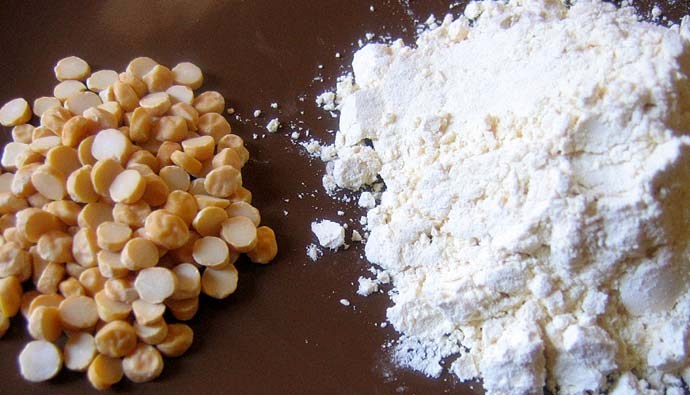
Chickpea flour is nothing more than dried chickpeas, ground to a flour-like consistency. Other names for chickpea flour include gram flour, cici flour and garbanzo bean flour. Besan is chickpea flour made with unroasted chickpeas. Chana is flour made from roasted chickpeas.

Nutritional Facts

One cup--92g--of chickpea flour provides 356 calories, including 52 calories from fat. A 1-cup serving of chickpea flour also contains 6g of total fat, 1g of saturated fat and no trans fat. With 53.2g of total carbohydrate, a cup of chickpea flour provides 18 percent of your recommended daily value--DV--of carbohydrate and 40 percent of the recommended DV of dietary fiber, as well as 41 percent of the recommended DV of protein. When you eat a 1-cup serving of chickpea flour, you'll also be getting vitamin A, vitamin K and several B-complex vitamins, including thiamin, riboflavin, niacin, pantothenic acid and a full day's supply of folate. Chickpea flour provides 25 percent of the DV for iron, 74 percent of the recommended DV for manganese, and various amounts of other trace elements and minerals, including calcium, magnesium, phosphorus, potassium, sodium, zinc, copper and selenium.


Availability

If your grocery store has an extensive international foods section, you may find chickpea flour in the Indian foods section under the names gram flour, besan or chana flour. Most groceries that sell Indian foods and ingredients carry chickpea flour, since it's a main ingredient in many Indian foods. Health food stores also carry a variety of non-wheat and gluten-free flours, often including chickpea flour. If you can't find chickpea flour locally, look for it through a health food supplier or co-op online.


Using Chickpea Flour in Recipes

Substitute 7/8 cup of chickpea flour for 1 cup of wheat flour for most baked goods. For yeast-raised breads, use 1 part chickpea flour to 4 parts wheat or spelt flour, says Margaret Wittenberg in "Good Food: The Complete Guide to Eating Well." In recipes that use flour for thickening, substitute chickpea flour for wheat flour or cornstarch on a one-to-one ratio. Use toasted chickpea flour for baking, Wittenberg advises, and untoasted for soups, fritters and dips such as hummus.


Read more: http://www.livestrong.com/article/160151-chickpea-flour-facts/#ixzz2PzLrWY6O

Friday, April 5, 2013

Crispy Roasted Chickpeas (Garbanzo Beans) - Recipe

Don't these look so yummy. These are Crispy Roasted Chickpeas and they are super easy to make. You only need 4 ingredients. Please go HERE to get the recipe and step-by-step instructions (with pictures).
You won't be sorry!

Thursday, April 4, 2013

Garbanzo Beans (Chickpeas)


Garbanzo beans are a versatile and tasty legume. They can be tossed into salads, roasted, stirred into stews and mashed into a tasty, Mediterranean dip. But these tiny legumes are not only delicious, they also offer a lot of nutritional value. If you don’t already have garbanzo beans as a staple in your pantry, after reading the following nutritional information, you will most likely want to.

Protein

Garbanzo beans are a great source of dietary protein. Vegetarians would do well to add garbanzo beans to their diets. When paired with whole grains, garbanzo beans provide a source of protein comparable to that of meat or dairy products, without the worry of saturated fat or cholesterol. One cup of garbanzo beans supplies roughly 27 percent of daily protein requirements.

Fiber

Garbanzo beans, like other legumes, are rich in dietary fiber. Garbanzos contain both soluble and insoluble fiber. Each type of fiber works in different ways to keep the body in healthy, working order. Soluble fiber works in the digestive tract to move excess cholesterol out of the body. Insoluble fiber helps to prevent constipation and other digestive disorders. One cup of garbanzo beans supplies almost half of the recommended daily allowance of dietary fiber.

Manganese

Garbanzo beans contain significant amounts of the trace mineral manganese. Manganese plays an important role in energy production. It’s also an important component in the body’s antioxidant activity.

Folate

Garbanzo beans are also a good source of folate. This nutrient is vital for women of childbearing years. Consuming adequate levels of folate prior to pregnancy can prevent certain birth defects, such as spina bifida. One cup of garbanzo beans contains 70 percent of the RDA for non-pregnant adults.

Iron

Garbanzos beans are a good source of iron. Iron is important for energy production. Deficiencies often result in fatigue. Iron is especially important to menstruating women, as significant amounts of the mineral can be lost due to heavy periods.

Selection

Garbanzo beans can be purchased dried or canned. Look for whole, uncracked beans that are free from moisture, when purchasing dried garbanzos. Canned beans are a convenient way to purchase garbanzos. Unlike vegetables, garbanzo bean’s nutritional components hold up well to the canning process. Their protein and fiber content are only lowered slightly when canned. However, canned garbanzos do have significantly lower levels of folate than the dried beans. The canning process can deplete folate levels as much as 45 percent.

Storage

Dried garbanzo beans are best stored in an airtight container. Place the container in a cool, dry place, away from sunlight, and they will keep for well up to a year. Once cooked, garbanzo beans may be placed in a container and stored in the refrigerator for 3 or 4 days.

Preparation

To lower their sodium content, drain and rinse canned garbanzos before use. Dried beans should be soaked prior to use. This is simple to do. Just place the garbanzo beans in a container of water and soak overnight.