Header

Facebook Pinterest Blog Home
Showing posts with label Baking. Show all posts

Friday, April 19, 2013

Secret Brownie Recipe


I have been craving brownies lately (mostly because I'm trying to stay away from refined sugars) so I decided to try and find a good recipe using coconut oil.
I found one! It is by Thriving Mom, you can visit her blog HERE.
This is what she says about her Secret Brownie Recipe

  • "Everyone who tries my homemade brownies says I have the bestchocolate brownie recipe around. Friends and family always ask me to make my famous brownies. People can't get enough chocolate of my moist brownies. I can't go to a social function without being asked to bring a batch. I'm known around town and my daughter's school as the brownie lady.

    Brownie recipes call for either oil, shortening, or butter. I tried many different brownie recipes of each kind. Personally, I am rather fond of the butter recipes, but my husband and all our family and friends think I've found a real winner with an oil based brownie recipe.

    Why is it so yummy? Because I use coconut oil instead of the usual vegetable oil.

    Now, I know what you're thinking...and no, it doesn't make the brownies taste like coconut any more than using vegetable oil would make them taste like vegetables. There is just something supremely rich about the coconut oil that adds a ton of flavor.

    This coconut oil brownie recipe makes a super moist brownie that's almost fudge like, but the chocolate taste is rather mild. This combination makes a divinely moist brownie that can be devoured since it is not overly rich."
You will find the Secret Brownie recipe HERE. 
I'm going to try it out today, if you do too let me know what you think.

Wednesday, April 10, 2013

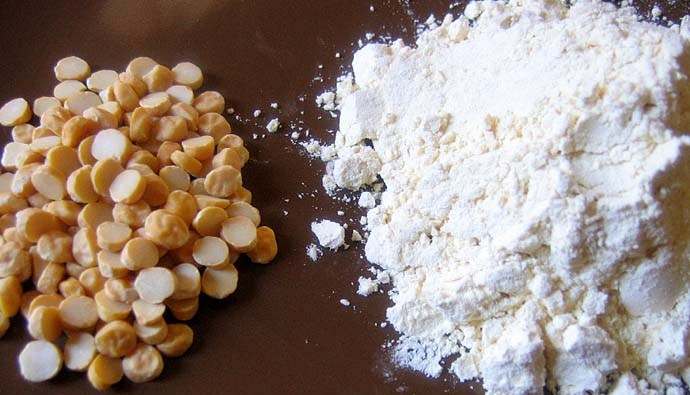
Make Your Own Chickpea Flour


You will find in some Indian, Turkish, Italian, Spanish and French recipes that it will ask for chickpea flour. But finding a store that stocks chickpea flour can be difficult. Here is how you can make your own in little to no time at all.
Chickpea flour — also known as besan, gram flour, channa flour, harina de garbanzo — is a popular ingredient in many Old World cuisines. It is the used in the batter for Indian pakoras. The French of Provence make a popular bread called soccawith it that they bake in wood-fired ovens. Persian Jews mix it with ground chicken to form gundi dumplings. Chickpea flour can also be a great substitute for wheat flour in many recipes and for thickening sauces. Good news for those who want to go gluten-free!
Here's how to make your own. It should yield around 1 1/2 cups.

Chickpea Flour Recipe

  • 2 cups of dried chickpeas
  1. Add the chickpeas in small batches to a food processor, coffee grinder or blender and process until pulverized and smooth.
  2. Run through a sieve to remove any large particles. Use as directed in recipes.
  • Toasted Chickpea Flour: toast the chickpeas in a 400°F oven for 15-20 minutes, or until the chickpeas start to give off a toasted aroma and are lightly browned. Cool and proceed with the recipe above.

Tuesday, April 9, 2013

What is Chickpea Flour?


In the United States, most people automatically think of wheat when a recipe calls for flour, but ground wheat is only one type of flour among dozens. Chickpea flour adds a nutty taste to baking, soups and sauces, and can substitute for wheat flour in most recipes. Both wheat-free and gluten-free, chickpea flour is also easier to digest than other wheat-flour substitutes, such as soy flour.


Identification

Chickpea flour is nothing more than dried chickpeas, ground to a flour-like consistency. Other names for chickpea flour include gram flour, cici flour and garbanzo bean flour. Besan is chickpea flour made with unroasted chickpeas. Chana is flour made from roasted chickpeas.

Nutritional Facts

One cup--92g--of chickpea flour provides 356 calories, including 52 calories from fat. A 1-cup serving of chickpea flour also contains 6g of total fat, 1g of saturated fat and no trans fat. With 53.2g of total carbohydrate, a cup of chickpea flour provides 18 percent of your recommended daily value--DV--of carbohydrate and 40 percent of the recommended DV of dietary fiber, as well as 41 percent of the recommended DV of protein. When you eat a 1-cup serving of chickpea flour, you'll also be getting vitamin A, vitamin K and several B-complex vitamins, including thiamin, riboflavin, niacin, pantothenic acid and a full day's supply of folate. Chickpea flour provides 25 percent of the DV for iron, 74 percent of the recommended DV for manganese, and various amounts of other trace elements and minerals, including calcium, magnesium, phosphorus, potassium, sodium, zinc, copper and selenium.


Availability

If your grocery store has an extensive international foods section, you may find chickpea flour in the Indian foods section under the names gram flour, besan or chana flour. Most groceries that sell Indian foods and ingredients carry chickpea flour, since it's a main ingredient in many Indian foods. Health food stores also carry a variety of non-wheat and gluten-free flours, often including chickpea flour. If you can't find chickpea flour locally, look for it through a health food supplier or co-op online.


Using Chickpea Flour in Recipes

Substitute 7/8 cup of chickpea flour for 1 cup of wheat flour for most baked goods. For yeast-raised breads, use 1 part chickpea flour to 4 parts wheat or spelt flour, says Margaret Wittenberg in "Good Food: The Complete Guide to Eating Well." In recipes that use flour for thickening, substitute chickpea flour for wheat flour or cornstarch on a one-to-one ratio. Use toasted chickpea flour for baking, Wittenberg advises, and untoasted for soups, fritters and dips such as hummus.


Read more: http://www.livestrong.com/article/160151-chickpea-flour-facts/#ixzz2PzLrWY6O

Wednesday, April 3, 2013

Whole Wheat Bread Recipe WITH Coconut Oil!?


WHOLE WHEAT BREAD

Put all of these ingredients in Bosch and mix well:

9 Rounded Cups fresh ground hard wheat
2 T Salt
½ C Powdered milk

Add:
½ C Expeller Pressed Coconut Oil (or oil of your choice)
½ C honey (or sugar of your choice)
2 T Lecithin (supplement)
3 Eggs
5 C of very hot water

Turn mixer on an d as soon as dry ingredients are moistened add 2 ½ rounded T of
LeSaffe dry yeast while mixer is running. You may need to add up to 3 C of WHITE
flour while it is mixing if the dough doesn’t begin to clean the sides of the bowl. Keep it
“sticky” – makes a better loaf.. Mix for 10 minutes on 3 speed.

Take the dough hook out and cover the dough in the bowl; let set until dough rises to the
top of the lid.

Put out on floured surface and divide into 6 loaves. Form into loaves and put into large
non stick pans. Cover and let rise in warm place. (If not using non stick pans it works
best if you put some type of oil or shortening in the pans).

Let raise until double (or light). Bake at 350 degrees for 35 minutes (ovens vary).

Monique Jackson's Wheat Bread Recipe


Monique Jackson’s Wheat Bread – September 2009


6 C warm water
2 T Vital Wheat Gluten
3/4 C oil
2 T Powdered Milk or Instant Milk
3/4 C honey
2 T Dough Enhancer
2 T yeast
2 T Salt
15 C wheat flour

Put all 8 ingredients in Bosch with 6 ups of ground wheat flour and mix on speed 1 for 1
minute. Watch to see that the yeast is active and forming bubbles. Add 9 C of remaining
wheat flour. Mix for 10 minutes. Butter counter, put dough on counter with butter side
up and let rest 10 minutes. Cut into 4 equal sections and mold into 4 buttered 2 pound
loaf pans. Turn oven on to 170 degrees for one minute and then turn oven off. Place
pans in oven and set timer for 30 minute. After 30 minutes turn oven to 350 degrees
leaving pans in oven while it warms to 350 degrees. Bake for 34 minute.

•    I’ve even baked this in a Solar Oven & it turns out fabulous!

Sunday, February 10, 2013

Spelt - 3 Tips to Higher Loaf Volume


Three tips to achieve higher loaf volume while using Spelt:

TIP #1
*  Take 1/2 of all ingredients (including the yeast), place in bowl and mix until you produce dough.
*  Cover and place in accessible spot for later use.
*  Within 5 to 12 hours add the remainder of all ingredients to the bowl (sponge dough), mix to produce the dough and proceed as you would normally.

Spelt flour is high in complex carbohydrates and, thus, needs to have some of the complex carbohydrates reduced to simple sugars so that the yeast will have a strong food source. By setting a sponge, you are releasing the enzymes in the flour that are activated when wet, to begin the conversion process. The resulting bread will have better cell structure, greater loaf volume and a lighter crust.

TIP #2

*  Replace some whole grain spelt flour with white flour - you will get more volume and a lighter loaf while still keeping many of the good characteristics of whole spelt.

TIP #3

* Add dough enhancer or an egg to your bread


Check out:  http://www.histakes-spelt.com  for more info on Spelt.  Excellent site.

Saturday, February 9, 2013

You can BAKE with Spelt


Question: What changes should you make when you add spelt to your dough mixtures for any baked good?

Baking with spelt is similar to baking with other flours, however, due to spelt's solubility, bakers often notice that a little less water is required. When using your favorite recipes, it is suggested that you use 3/4 of the liquid that you normally would use. More liquid can then be added until the look and feel of the batter is satisfactory.

**Be sure you make note of what you do so you can repeat your successes**

Spelt has fragile gluten meaning that the initial mix time (when water is first added to the flour) should be no more than 4 minutes - although 3 1/2 minutes is ideal.

Mix the flour/liquid enough to get the dough to become homogenous.
Once mixed, you can treat the dough as though it were made with regular wheat.


Check out www.histakes-spelt.com for more information & recipes